Here are some quick thoughts about my experience teaching some writing-heavy music classes this year. It’s not so hopeless!
This past year at NYU, I’ve taught 4 sections of an advanced pop music theory course, and 5 of an advanced pop aural skills course. These classes have a lot of writing in them, and I feel good about the methods I’ve used to get students to really engage with that material.
In terms of ChatGPT and other LLMs, I don’t outlaw them. Being a cop in that regard opens up too much of a can of worms for me, particularly as an adjunct.
But in music contexts especially, I feel I’m good at picking out LLM prose and ideas. First, the made up facts about the readings are quite notable. Second, LLMS spit out generic corporate-speak, which sticks out like a sore thumb when writing about art. Because it spits out THIS bad writing, the assignment submissions that use it just get bad grades. So that’s a big disincentive to use it. In general, my feedback for those submissions is “LLM-y language,” whether they actively used it to spit out an answer in this case, or have just used it so much already that their writing sounds like an LLM. From there, the idea is to show what good (not-LLM) writing and thinking looks like.
On the positive feedback front, I encourage word vomit, parenthetical asides, bullet points, just really informal writing in general. I emphasize that these responses are my opportunity to get to know how you think, whatever that may be. The relationship building is as important as the content produced. Classic process over product. Theory class has 2 informal writing assignments per week, and Aurals has 1 per week that pairs with a transcription. Those assignments are preparation for a seminar discussion, so even if the ideas aren’t there in the responses, the discussion helps model the kinds of critical thinking that leads to good insight. Also, since the students get along well and are really supportive of each other, a really good discussion comment will get peer praise, making that a memorable model of what a good interpretation sounds like.
By the end of this semester, I’ve seen overall usage go down. There are a few “super users” who are still using it to crank out plausible prose, but, the ideas are much better. It feels like to me that they’re thinking critically at the start, and using the LLM as a prose generator/editor from there. Still not perfect, but much better at the core.
Part of why this works for me is:
A) I’m a fast reader and can grade these responses quickly
B) I’m trusting that the real learning and feedback comes from the discussion rather than my feedback, so I don’t put too much pressure on myself on that front
C) this is the end of the line for the theory and aurals sequence, so I don’t have to worry about getting students prepared for the next step in the sequence, skills wise
D) I’m an adjunct, but have a very supportive chair, a union, and got to design much of the courses, so it’s almost all material that I personally enjoy
Again, this won’t be applicable everywhere, but it’s a start.
In general, I’ve felt that this has been a particularly satisfying semester, teaching-wise. I’ve gotten a sense from the students that music is a real refuge where things still make some sense. And because they really want to immerse themselves in music, there isn’t as much of a desire to outsource that immersion to LLMs.
Last night, I got to check out a good chunk of Morton Feldman’s monumental trio “For Philip Guston,” performed by flautist Emi Ferguson, pianist Adam Tendler, and percussionist Nathan Davis at the Hauser & Wirth Gallery in Chelsea. This was the first time I had heard the piece, and over the course of my 2 and a half hours of listening, I wrote down some idle thoughts. In the spirit of Feldman’s colleague John Cage’s love of automatic writing, here are my unabridged (and honestly, a bit strange) idle thoughts:
Feldman music is a baseball game with no actions
just the movements between pitches
Getting new balls from the catcher
Stretching the glove
Getting in position
Adjusting the hat
Base coach signs
Stepping off the rubber
Adjusting batting gloves
Kicking dirt off cleats
Take hat off wipe sweat
Stretching arm
Soft toss with outfielders
Around the horn after a strikeout
Holding up outs
Repositioning fielders
Squatting, getting up
Chatting with basecoaches
A Feldman performance art piece on a baseball field lol
variety of NY uniforms of different teams and eras
More extreme field of dreams
Great at twilight with lights switching on
Hecksher fields to close to Lincoln center haha
Shofar calls
Noir chord!
Pump Feldman into baseball practice sessions
I64 to IV shifts lol – sample that!
1 hour in ish
Feldman has to be equal tempered, doesn’t it? Something about that steadiness, but unsettled. Just intonation would settle it too much
He’s not making “effects” like spectralists and lachenmannists
no perceptual games, literal sound transformations
Experience is all essentially metaphor
Sound is/for a person; not a one-to-one thing
Spectralists want Pantone shades, Feldman just mixes from what’s at hand
Feldman’s materiality lol
What Scott hears…
Who would that be for me?
Contemporary big band?
Man I love this pop chord thing
What gives cadence (ie cue to leave)
big texture shift
Analysis via audience action
Musician attention
never enough pause to lose it
Centering each action
So… here it is, conscious, very little automatic
Have I been here before? Even if you actually have, you’re really not sure
that’s pretty magical, to make a return and it’s not obvious, but just is
Not like a “hidden return”
Just the thing itself isn’t quite memorable
Minor to altered dominant (child is born haha)
especially with the 4ths, yazz baby
Low!!!!! Octave!!!!
Makes a Tritone feel like a 5th
What does it mean to count?
a piece of counting
Not just the act, but the what
What constitutes something that can be counted
A lesser composer would end on this 5th thing
oo nice major minor thing
More samples!!!
What is low Feldman?
beginning of my bassoon bass clarinet thing (which doesn’t read Feldman because Feldman isn’t low haha)
I like how many flute changes right at the beginning. Exhaust that right away and then it’s not a “thing”
except now that there’s been so little piccolo for a while, it’s entrance feels like a thing
But everything else is new and distinctive too, that it’s probably meant to be a thing
And the unison actions too
Jump cut!!!
this FEELS loud, like super distorted guitar turned way down
Groove!!??
Curious thinking about how long this groove will go for
amuse bouche, or is it gonna realllllly sit
Also how it’s gonna stop
Feeling like a Reich process piece, flute pulling out the melodies from the rhythm field
Ok, kind of a sit
groove kind of evolves, but not as clear, still more dense than rest
Flute is still doing its thing, so big threading overlap
Then just a new thing
Sunday chord hahahahaha
Minor quartal jazz again
Rain rain…
After a few times, the countable things become clearer. Less “have I been here before” than “I’ve been here before.” But in this case this certainty might be deceiving! The opposite experience of before
Does this count as an egobituary because it’s not quite like Guston is making Feldman write differently?
granted what do these materials mean to Feldman
Chromatic planing? Ravel-jazz
Pop chords again – I vi
I think he’s conscious of tonal implications because the most tonal harmonic sets are typically the most fleeting
Ornaments!!??
Gotta say these are good chairs for this time frame
Young at heart lifting motive
This does feel sappier than crippled symmetry
Some objects are more countable than others
Some countable objects are probably attached to less countable objects
This octave leap section is more crippled symmetry
Quantized pitch is so important, the smooth transitions become remarkable in that quantum way. You know it jumps, but you see a smooth line
Sunday chord again
let’s see if it’s quick again
Ok. This seems pretty close to explicit repeat of last time Sunday chord came in
Different minor planing, closer to the noir bit earlier
again, have I been here before? It feels familiar, but I can’t quite tell
But it invites knowing
Augmented major 7…
feels more Sondheim tension chord to me now than girlfriend chord
Maybe it’s the specific voicing, and this is not a jazz voicing
I like this sense of Emi just sitting on a chair in her living room, cross-legged and playing long tones. Not a performance, musicians chilling
Uh oh… piccolo time!
This one feels less of a thing because starting in that lowest register
Whole step alternating reminds me of my first piano pieces, also, I wanna get out
Colors radiate from a point, width via radiation rather than microtones
Ooo, my favorite Feldman sonority, M7 + M2
Is it just me or were we without Celeste for quite a while until now?
The music that fills a life
Groove, kinda half time, or at least I’m grafting that onto what’s happening
In this week’s New Yorker, Alex Ross has a lovely and thoughtful piece on the nature of noise. He looks at it from many angles—etymological, aesthetic, political, technological… One of Ross’s insights is that the division between say music and noise is one of power or aggression. Electing to listen to the unrelenting sounds of Merzbow is very different than getting stuck in a hotel next to party, even if the decibels of the former are much greater than the latter!
The piece got me thinking about a short journal entry I wrote for a grad school class back in 2018. While Ross ponders the dividing line between noise and music, I thought about the nature of silence versus quiet. So here it is, with a major hat tip to Rebecca Solnit, and some musings on John Cage, Colin Kaepernick, and Megan Rapinoe:
In 1951, composer John Cage visited an anechoic chamber at Harvard University. This room was designed to absorb any possible sound made within it, rather than reflect it back toward a listener. When Cage entered this supposedly silent room, he instead noted that “…I heard two sounds, one high and one low. When I described them to the engineer in charge, he informed me that the high one was my nervous system in operation, the low one my blood in circulation.” Less than a year later, in August 1952, pianist David Tudor gave the premiere of what would become Cage’s most famous (or infamous) work—4’33”. Composed in three movements, the work calls for a pianist (or other instrumentalist) to simply sit on stage and make no intentionally “musical” sound for the allotted time. When recalling the piece’s premiere, Cage noted, “There’s no such thing as silence. You could hear the wind stirring outside during the first movement. During the second, raindrops began pattering the roof, and during the third people themselves made all kinds of interesting sounds as they talked or walked out.”
Cage’s experience in the anechoic chamber and his 4’33” pose a striking challenge to the notion of silence as an acoustical phenomenon—even in an ideal acoustical environment, the complete absence of sound is impossible (at least for those with no auditory disabilities). Acoustically-speaking, silence and quiet are identical physical phenomena, meaning their psychic differences must arise from another source. In her essay “A Short History of Silence,” Rebecca Solnit posits “silence as what is imposed and quiet as what is sought.” She continues, “The tranquility of a quiet place, of quieting one’s own mind, of a retreat from words and bustle, is acoustically the same as the silence of intimidation or repression but psychically and politically something entirely different.” In Solnit’s view, silence is authoritarian, while quiet can be liberating, “making room for the speech of others.”
Seeing silence and quiet as a political dichotomy squares with Cage’s influential aesthetic. In a public speaking contest at the Hollywood Bowl that Cage won as a teenager, he proclaimed, “We should be hushed and silent, and we should have the opportunity to learn what other people think.” Many of the pieces he composed in the years leading up to 4’33” are quite subdued, exploring the lowest dynamics of musical instruments. “When the war came along, I decided to use only quiet sounds,” Cage noted in a retrospective interview. “There seemed to be no truth, no good, in anything big in society. But quiet sounds were like loneliness, or love, or friendship.” In contrast to the mythic, Western ideal that a great piece of music must be a profound utterance of a singular (and male) genius, Cage’s pieces of the 1940s and early 50s create a resistant practice to that notion, one that invites a listener to create their own, subjective experience. While the so-called “great works” of the European classical music tradition demanded submissive silence (no applause between movements!), the works of Cage and many of his contemporaries upend this hierarchical relationship between the art and its participants (whether maker, interpreter, audience, or some combination). In short, quiet art listens and liberates.
This notion of silence and quiet as opposed, rather than similar phenomena can help explain the potency of certain protest practices. One of the most talked-about protest practices in contemporary America are the Black Lives Matter protest actions carried out by athletes during the playing of the US national anthem before sporting events. These protests by high-profile figures (like former NFL player Colin Kaepernick and US soccer star Megan Rapinoe) and school-aged players alike are distinctly quiet in nature—a reverent kneel, a position associated with mind-quieting spiritual practice. What gives these acts the potency of spectacle is the fact that this quietude is practiced in direct juxtaposition with the national anthem’s practice of authoritarian silence. The acoustical experience of the song itself is less vital than the enforced silence that surrounds it (please rise and remove your caps). By performing a personal, quiet act in response to a monolithic, silent one, these protesters upend the power dynamic of the US national anthem ritual, similar to how 4’33” upends the power dynamic of the classical concert hall.
At the end of “A Short History of Silence,” Rebecca Solnit emphasizes the importance “…of using any privilege we may have been handed to undo privilege or expand its scope.” Professional athletes and successful artists alike have significant privilege and status—they have speaking platforms from which to be heard and valued. A quiet act from this space of privilege does exactly what Solnit advocates, inviting others in. Silenced listeners are now performers whose sounds and stories can be heard.
Yesterday, my composition teacher Jim Primosch died of cancer. Many of Jim’s colleagues and students have been sharing memories online, and I’d like to offer one here.
Like my fellow Penn composers Melissa Dunphy and Nathan Courtright, I’m remembering one of those lesson moments with him when something big clicked.
This was my last semester of coursework, and I was just starting my dissertation piece—a quixotic evening-length extravaganza for singers and improvising instrumentalists. I had not written any vocal music at Penn, and now I was thinking that I was going to write 60-plus minutes of it.
Jim, on the other hand, writes the most incredible vocal music. I was understandably very nervous about bringing my first ideas in to our lessons. One magical thing about Jim’s vocal music is that he can take texts that are so rich on their own, and write music that fits so perfectly and doesn’t weigh the text down. It’s so hard to do. I reaaalllly wanted to do that in this piece.
So I brought in this poem “Oystercatchers in Flight” by Eamon Grennan, and the beginnings of a solo melodic line. Jim began to read the text and his mouth curled in an impish grin.
“I want to set this text,” he chuckled.
I sang him the line, and then we improvised together, jumping between singing and the piano, thinking about how to activate the breathless run-on sentence of a poem. That moment of recognition gave me the confidence to plunge into writing 70 minutes of vocal music; the confidence that I had something to say.
May Jim rest in piece, and may all who knew and loved him be comforted and sustained.
The Kaufman Music Center in NYC has been organizing these fantastic pop-up concerts in storefronts near Lincoln Center. They’ve had some real heavies play, like Gil Shaham, Jessie Montgomery, and JACK Quartet. Last week, my good friends of Warp Trio played a few sets, and dusted off “A Thousand Skies” for the first time since COVID. Here’s a little bit more of their set:
Little did Warp know that playing something of mine at a Kaufman event is particularly meaningful for me – my great aunt Sue Shapiro was a big supporter of Kaufman, and would organize concerts with students from the Lucy Moses School at her retirement community in northern NJ. There she is, standing on the right!
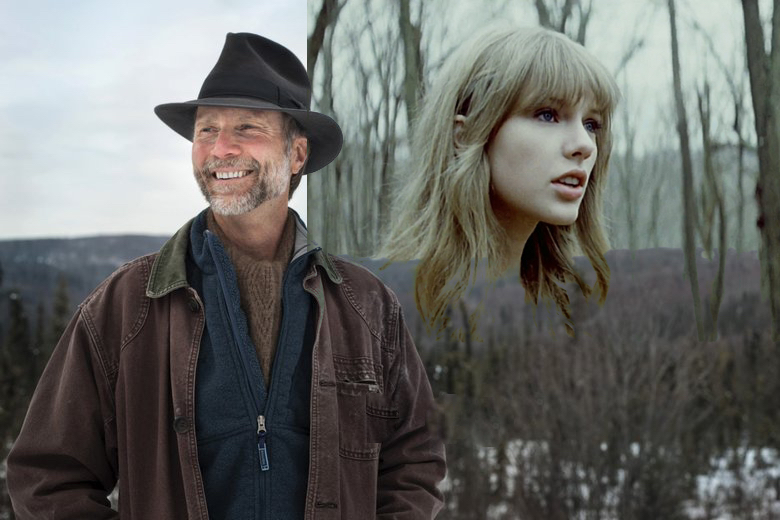
In the fall of 2015, Taylor Swift made a $50,000 donation to the Seattle Symphony. In a letter to the orchestra’s music director, Ludovic Morlot, she said the donation was inspired by listening to the orchestra’s recording of Become Ocean, the Pulitzer Prize-winning piece by composer John Luther Adams. Adams himself was delighted by the gesture, and wrote hopefully, “Through her generosity and her open ears, Taylor Swift is inviting her fans to experience a new and different kind of music.”
This week, in addition to dropping her seventh studio album, Lover, Swift noted in interviews that she is planning to re-record her first five albums to gain artistic and financial control over her material, after her masters were sold by her old record company.
In addition to re-recording her songs in their original form, perhaps it could be fun to throw in some remixed goodies as well. What if Swift teamed up with her favorite contemporary composer for one of those remixes? And what if it was of my personal favorite song “Blank Space?”
With the premiere of Almanac coming up tomorrow, I wanted to share some sketches and other goodies from the piece. If you’re curious about nerdy composer stuff, read on!
Movement III – Oystercatchers in Flight
The first part of Almanac that I wrote was a setting of Eamon Grennan’s poem “Oystercatchers in Flight,” which is now the third movement. To help constrain my pitch choices, I used some *gasp* serial technique! I can’t say that I use it a lot, and Schoenberg and Babbitt wouldn’t be too happy about how I used it here, which is to say relatively un-systematically.
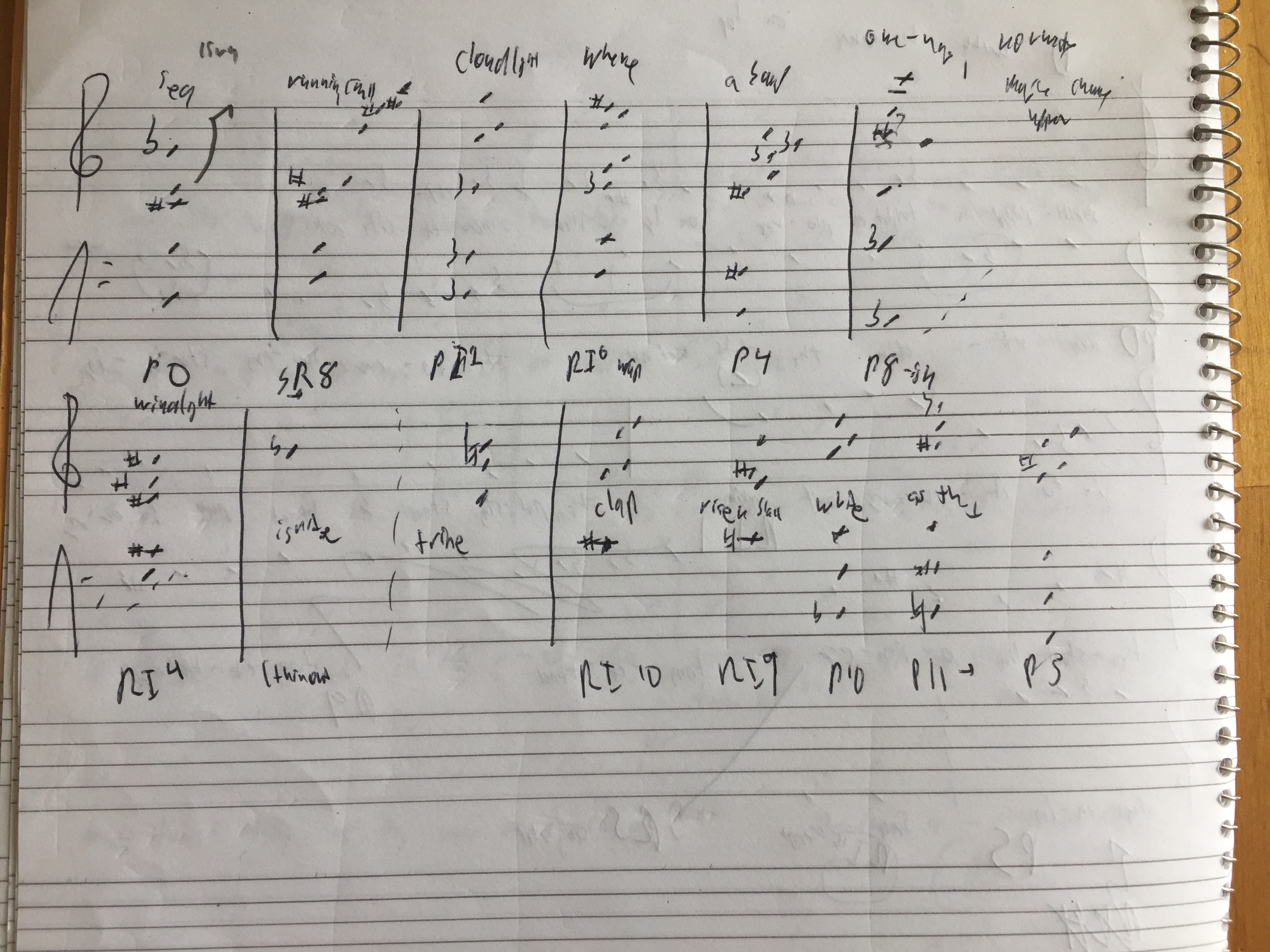
A lot of the pitches in the movement are derived from this twelve note chord (labeled P0 in this first sketch).
The chord features a lot of different colors that I like—stacked fifths, whole tone segments, and this kind of major-7 with a sharpened/distorted octave on top. From there, I started writing the vocal line, which you can see in this second sketch.
The first segment uses pitches from that original chord, but the later segments were written much more intuitively. After writing the line, I figured out serially-derived alterations of the main chord that would more-or-less fit the different melodic segments, which you can see in the third sketch.
With all of those materials in place, it became a matter of writing lines that fit the harmonic plan and helped place the voice in the middle of a cold but kinetic landscape, like in this score example.Continue reading →
A performance of symphony for broken instruments at the 23rd Street Armory, Philadelphia
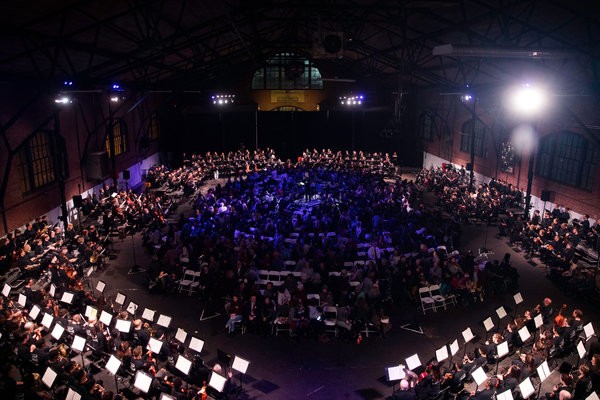
“Why didn’t they fix the instruments first, and then have us play the piece,” asked a middle-aged man sitting in front of me. He was fiddling with the third valve of an old trumpet, trying to free it from its stuck position. We were at a rehearsal for the project Symphony for a Broken Orchestra, a large civic art project in Philadelphia that went up in the Fall of 2017. As one of the twenty-five section leaders, it was my task to help teach the piece symphony for broken instruments by the composer David Lang to some of the 400 professional and amateur musicians who had signed up to play.
“I’m not sure,” I answered. The man with the trumpet looked a little dismayed, seemingly concerned that the so-called section leader didn’t have a better idea of what was going on. Trying to save face, I continued, “I feel that not knowing how this all works can actually be a good thing. We’re figuring out how to make music in a different way than we’re used to. We’re going to try a lot of different things today, so let’s be open to whatever happens.”
“Trust the process,” my fellow section-leader Ben chimed in, repeating the mantra of Philadelphia’s long-improving professional basketball team. A few of the prepping musicians chuckled.
Although I didn’t have a good reason at the time why we were playing a symphony for broken instruments, rather than a symphony for instruments that used to be broken, but are now fixed and good as new, it’s clear to me now that project’s practical effectiveness and compelling artistry depended on those instruments’ brokenness. The project as a whole, and Lang’s composition in particular, transformed the essential hierarchical relationships of a typical orchestral performance. These relationship transformations turned the instruments into performative agents who could tell their previously-hidden stories of trauma and neglect. Continue reading →
In the fall of 1996, composer Gavin Chuck and conductor Alan Pierson were students at the Eastman School of Music in Rochester, NY. They met at a party and began to talk about the contemporary music scene at the school. Chuck voiced his frustrations about the difficulties student composers faced in getting work for large ensemble performed, whether in school-sanctioned readings with the full orchestra, or in performances with hastily-rehearsed pickup groups. Pierson noted that among all of the contemporary music concerts at the school, none featured music by minimalist composers. Their conversation soon ballooned to include more friends, setting in motion a sequence of events that led to the creation of Eastman’s first student-run contemporary music group, Ossia, as well as the acclaimed and influential contemporary orchestra, Alarm Will Sound, which had its first performance under the baton of Mr. Pierson in May 2001.[1]
At the time of its founding, Alarm Will Sound was a rare bird in the contemporary music world. Many of its members were both composers and performers, and the group rehearsed collaboratively—a setup that put them in league with the social world of downtown minimalism. However, the members also all studied at one of the United States’ august conservatories and many of their early gigs were at Columbia University’s Miller Theatre, performing the work of academic modernists like György Ligeti, Harrison Birtwistle, and Augusta Read Thomas. This combination of intense, traditional conservatory training and a democratic, collaborative mindset to rehearsing and repertoire is reflected in the variety and creativity of their recorded projects, which not only feature works by composers as diverse Steve Reich, Conlon Nancarrow, and Charles Wuorinen, but also arrangements of music from outside the concert music world, including the Beatles’ “Revolution 9” and the work of Richard D. James, aka Aphex Twin.
What’s most surprising about the group and their repertoire isn’t that classically-trained musicians can be interested in a huge range of music (just think of Gunther Schuller’s engagement with jazz, or Milton Babbit’s encyclopedic knowledge of musical theater). The real surprise is how influential Alarm Will Sound’s approach has become throughout the contemporary music scene around the United States. Groups like Ensemble Signal in New York, Contemporaneous (founded by students at Bard College), and wildUp in Los Angeles not only feature similar sizes/instrumentations as Alarm Will Sound, but also variety of repertoire. Other groups like Wet Ink feature composer-performers who both write for the group as a whole and perform their peers’ work. The piano/percussion quartet Yarn/Wire—another regular at the Miller Theatre Composers’ Portrait series—has premiered work by composers as diverse as Tristan Murail, orchestrally-minded singer-songwriter Sufjan Stevens, and the experimental electronic musician Pete Swanson.
This proliferation of groups who create their own repertoire through some combination of collaborative composition, improvisation, and commissioning marks a sea change in how contemporary concert music gets made in the United States. Top-down institutions like universities, conservatories, and large arts organizations like symphony orchestras have lost profound influence as tastemakers and producers to these grass-roots ensembles. In this new world, academic music institutions are faced with a particular quandary—how can they simultaneously preserve the rigorous traditions of classical training while simultaneously preparing students to become creative and collaborative musicians in this wide-open, self-directed contemporary music scene? By looking into how and why ensembles like Alarm Will Sound make music in a particular way, these academic institutions can learn how to adapt their teaching for the music scene’s next generation of multi-faceted music-makers.
A good place to start in this discussion of music and pedagogy is to define what groups like Alarm Will Sound do. The kind of collaborative music-making that powers Alarm Will Sound has an analog in the theatre world—devised theatre. In a work of devised theatre, a script is created collaboratively by a group of actors, many times through improvisation, or short prepared excerpts known as etudes. In this way, the writing and rehearsal processes of the theatre piece are the same, rather than split between different people and places. Using the concept of devised theatre as a jumping-off point, devised music is a form of music-making where the performers have a greater degree of control over the music they perform than in a typical classical situation. In a traditional classical model, the performers interpret a work of music through performance, but do not have the agency to change the notes written on the page—they can affect how a piece sounds, but less of what sounds in a piece. Groups that make devised music can determine the what of a piece in addition to the how in three major ways:
They can collaboratively compose music through group improvisation. These typically include groups with strong connections to the jazz tradition, like Anthony Braxton’s or John Zorn’s ensembles.
Different performer-composers in a group write or arrange music for the group to play, with other performer-composers having some degree of editorial input. These include groups like Alarm Will Sound and Wet Ink.
A group can curate its unique repertoire by commissioning an outside composer to write a piece, yet also have editorial control over the work via a collaborative process. Groups like So Percussion and Yarn/Wire, among many others, frequently work in this way.
Now that we have a working definition of what devised music is, we can look into an example of successful devised music and explore how its devised nature affects its result—how the process leads to its product—and the various source materials that go into the work, whether from within the traditions of western concert music or without. The example I’d like to explore here is Alarm Will Sound’s 2005 record Acoustica, featuring arrangements by group members of pieces by the electronic music artist Aphex Twin.
The original pitch for making acoustic arrangements of electronic music came from group violinist-vocalist-composer Caleb Burhans. While many members of Alarm Will Sound were intrigued by the notion by adding another layer of human input to a form of music that was already based on samplings of preexisting sounds, others were worried. Gavin Chuck notes that one member questioned whether the project would “…end up being like The New York Philharmonic Plays the Bee Gees.”[2] The group decided that the music of Aphex Twin would yield the meatiest results, with its breakneck tempos, rich soundworld, and dramatic jump cuts.
While each arrangement from the record is credited to a single group member, the pieces were workshopped extensively. There were disagreements about how close the arrangements should hew to the source material, or what a certain note or rhythm was within a dense texture. Alarm Will Sound explored their instruments collectively, finding out the best ways to mimic electronic sound through acoustic means. Their catalog of extended techniques and nonstandard percussion instruments purchased from hardware stores could be used throughout all of the arrangements, creating a unified soundworld. In this way, the results of the Acoustica project are profoundly impacted by the collaborative creative process. From conception to execution, the physical music was shaped as much, if not more, in the rehearsal hall than in an individual’s composition studio. One can imagine what a less collaborative Acoustica project would have sounded like. Composers would have offered arrangements that only scratched the surface of possibilities in terms of what acoustic instruments could achieve when imitating electronic sounds. Some composers might try to reproduce tracks exactly, while others may have hit walls in trying to mimic Aphex Twin’s complex sounds and opted for safer, more cover-oriented material.[3] In the end, this version of Acoustica would have been a curious experiment, a bit of let’s-be-hip crossover, rather than a deeply considered and holistically-constructed work. Instead, Acoustica as conceived and produced by Alarm Will Sound shows the exciting possibilities of collaborative devised music.
The fact that Acoustica was produced in a collaborative environment isn’t its only defining feature. It’s also important to note how the project arose from various musical sources, both within and without Alarm Will Sound’s classical training. It is not enough to note that Acoustica is a work of classically-trained musicians performing vernacular music. If that was all it was, its interest would be no greater than the aforementioned “New York Philharmonic plays The Bee-Gees.” What is interesting about the project is how the musicians both leverage and expand their conservatory training to execute the non-idiomatic difficulties found in the music of Aphex Twin. On a surface level, the performances on the album showcase the players’ command of their respective instruments. The clarity of fast runs reflect study of virtuosic showpieces, while the range of extended techniques used reflect deep experience with post-World War II concert music. From an arrangement standpoint, the writers use their ear training to figure out complex rhythms and melodic contours, as well as the components of multi-faceted textures.
While traditional conservatory training is a necessary part of Acoustica’s performance practice, it is not sufficient. The kind of rhythmic accuracy needed to convincingly perform Aphex Twin’s music, particularly in regards to syncopation, is usually overlooked in classical training, as it is not a significant part of western concert music (certain works of minimalism excepted). In particular, percussionist Jason Treuting is a virtuosic drum set player with enough experience playing rock, funk, and jazz to give Aphex Twin’s frenetic breakbeats the right rhythmic feel—a skill that isn’t formally taught in a typical conservatory percussion course of study. In order to play the music on Acoustica effectively, the players of Alarm Will Sound had to expand on their training and learn new, non-classical performance practices in a self-directed way.
Alarm Will Sound’s arrangement and performance of Aphex Twin on Acoustica is an effective work of devised music because of three main ingredients:
A strong concept regarding the nature of control in different kinds of music, motivating the combination of vernacular electronic music and acoustic classical instruments
A collaborative creative process that opened up a unified soundworld and quality of performance across the varied arrangements
The players’ ability to both leverage their classical training and expand upon it to accurately convey the nuances of the non-classical source material
With these characteristics in mind, let’s return to the discussion of how to teach devised music in a conservatory environment, in order to better prepare students for today’s wide-open, grass-roots contemporary music world and inspire strong new work like Acoustica. The essential ingredients of Acoustica’s success have implications in the teaching of critical and creative thinking, collaborative rehearsal, and technical training at American conservatories. With the expressed goal of fostering effective devised music in the conservatory and the greater contemporary music scene, I have the following recommendations:
Strong devised music projects have a deeply-considered underlying concept that motivates the particular combination of repertoire, performance practice, and creative rehearsal process. These strong concepts require musicians to think critically and creatively about the music they listen to and perform. In order to inspire this kind of thinking, conservatories should better emphasize study in music history and liberal arts among performers and composers. This does not necessarily mean adding additional coursework. Instead, courses should move away from tired and simple surveys, instead taking a more interdisciplinary approach. An effective music history course could focus on the influence of electronic sound on acoustic music across different genres (looking at the work of Ligeti, Acoustica, and the bluegrass band Punch Brothers, to name a few). These academic courses should stimulate independent thinking and create opportunities for individualized projects based on students’ interests, rather than ticking off arbitrary requirements.
In order to foster a spirit of creative collaboration in students, conservatories should follow Eastman’s lead and create student-run contemporary music ensembles, or at least give students significant governing power in a departmental contemporary music ensemble. Beyond this, faculty should reevaluate how they teach chamber music. Instead of coaching groups from outside the performance or via conducting, teachers can embed themselves in groups, teaching the necessary skills of chamber music in a constructivist fashion through example. Many of the groups that I’ve mentioned in this article take this approach at the summer festivals they run, including Yarn/Wire and So Percussion (it is telling that three successful percussion groups have come out the inaugural class of the So Percussion Summer Institute in 2009).
Instrumental and musicianship training at the conservatory should reflect a broader range of music from outside the classical tradition. Conservatories should mandate a course in improvisation (Stony Brook University’s improvisation class led by trombonist Ray Anderson is a good example) and change the musicianship curriculum to encompass more diverse music (i.e. transcribing jazz solos or Indian classical music, or learning fiddle tunes by ear). In lessons and chamber music, students should be required to perform pieces that require non-classical performance practices, like string quartet pieces from the Brooklyn Rider Almanac, for example.
Individually, these recommendations can better prepare conservatory students for today’s contemporary music world, but collectively, they build on each other to inspire thoughtful and creative musicianship, rather than just good musicianship. For instance, a violin student may enjoy transcribing a James Brown vocal line in musicianship class, which could lead her to the Brown-inspired string quartet piece Dig The Say by Vijay Iyer that she’ll put together with a group of friends for chamber music class, which could then motivate a larger project that interfaces with vernacular dance traditions. With studio work and narrowly-focused institutional (i.e. orchestra) jobs fewer and farther between, academic music training in the United States must adjust to this new reality. These changes are not mere practical realism, however. More importantly, they effectively foster the creation of exciting and relevant new work for the concert hall and beyond.
David Bowie—the artist who transcended style and media and form and perhaps his own self—died yesterday, 2 days after his 69th birthday and the release of what is now his final album, Blackstar.
The tributes and remembrances that I’ve seen today have been moving and wide-ranging, reflecting Bowie’s unique influence on listeners of all kinds. Composer/violinist/Arcade Fire member Owen Pallett has a touching story about having dinner with Bowie back in 2005. Author Elizabeth Gilbert is overwhelmed by Bowie’s making art in the face of death. And actor Simon Pegg put it beautifully and succinctly:
“If you’re sad today, just remember the world is over 4 billion years old and you somehow managed to exist at the same time as David Bowie.”
Like Gilbert, I am deeply moved by Bowie’s ability not just to create while confronting his mortality head on, but to continue to stretch himself in new directions. I’ve not only admired Bowie’s ability to reinvent himself (rock’s version of a Stravinsky or Miles Davis), but also his collaborative approach—how he embraces the knowledge and insight of others to expand his art’s expressive range.
Blackstar (and his previous single “Sue (Or in a Season of Crime)” released in October 2014), find Bowie once again challenging himself to expand his art through collaboration, this time with New York jazz musicians (many of whom I’ve written about here and at Jazz Speaks). Sitting at home on this cold and sunny afternoon, all I can think of to do is delve into this valedictory work and bid farewell to this inimitable human being.
Track 1: Blackstar
This is a sprawling odyssey, but the direction of motion is uncertain. Mark Guiliana’s drumming is energetic and intense, but also brutally syncopated, as if gracefully tap dancing in lead shoes. The other band members seem to be moving at different speeds and in different directions. Guitarist Ben Monder’s fingerpicking is relaxed, peacefully drifting through keyboardist Jason Lindner’s vintage synth patches, while saxophonist Donny McCaslin swoops in and out with melodic fragments that move at yet a different rate. The atmosphere is simultaneously tranquil and deeply unsettling.
Bowie’s vocals are striking and declamatory, almost a sacred chorale. He harmonizes himself, an ethereal falsetto floating an octave and a fifth above his main note. That interval is part of the harmonic series, meaning that the two pitches, though far apart, are proportionally related and fuse in the mind. It’s as if I’m hearing both Bowie’s earthly and heavenly voices simultaneously. Both Bowie’s voice and McCaslin’s saxophone are mixed in a way to make it seem that the performers are moving in space in relation to me as the listener. Sometimes, they seem far away, other times close up. Sometimes they move from my right to my left side. It’s disorienting and positively spine-tingling.
At about four minutes in, the rhythms break down, the song reaching a place of restless repose. A new major-key chord progression enters, surrounded by the opening section’s fizzy haze. Bowie intones:
Something happened on the day he died
Spirit rose a metre and stepped aside
Somebody else took his place, and bravely cried
(I’m a blackstar, I’m a blackstar)
Poignancy aside, I’m really curious about the meaning of the word “blackstar,” particularly in how he contrasts it with not being a “gangstar,” “film star,” “pop star,” “marvel star,” “white star,””porn star,” or “wandering star.” Maybe it’s just the fact that the lyrics move to the second person, with Bowie addressing some unknown you, but I get a sort of Walt Whitman-esque feeling here. Perhaps “blackstar” is a way of saying that “I contain multitudes,” that this bridge is a sort of bizarro Song of Myself. After hearing the obtuse lyrics of the opening section that can disorient or alienate, Bowie is inviting the listener to ponder them, explore the blackness and the mystery. The things that the listener may not understand in a Bowie song are just as much an authentic part of him as the things that the listener can understand. This simultaneous disorientation and embrace is something that I experience in a lot of great music. I think jazz pianist Brad Mehldau puts it pretty well when he describes the music of Miles Davis and John Coltrane. It’s like they’re saying: Continue reading →

 In the fall of 2015, Taylor Swift made a $50,000 donation to the Seattle Symphony. In a letter to the orchestra’s music director, Ludovic Morlot, she said the donation was inspired by listening to the orchestra’s recording of Become Ocean, the Pulitzer Prize-winning piece by composer John Luther Adams. Adams himself was delighted by the gesture, and wrote hopefully, “Through her generosity and her open ears, Taylor Swift is inviting her fans to experience a new and different kind of music.”
 With the premiere of Almanac coming up tomorrow, I wanted to share some sketches and other goodies from the piece. If you’re curious about nerdy composer stuff, read on!


 Kevin Laskey